In the aftermath of conflict, reconciliation is often the first word to arrive and the last to be questioned. It appears in UN resolutions, donor recovery frameworks, and national transition plans as both a moral necessity and a technical solution, the social mechanism through which societies are expected to move forward once armed violence subsides. Reconciliation is framed as the emotional and communal counterpart to military victory, promising healing, coexistence, and a return to normal life.
Yet across post-conflict settings globally, reconciliation rarely functions in the way this language suggests. Rather than emerging organically from justice or accountability, it is increasingly deployed as a governing logic, one that allows states and international institutions to stabilise territory, manage populations, and exit conflict zones without confronting the political and legal consequences of mass violence. In this formulation, reconciliation does not follow justice. It arrives in its place.
Using post-ISIS Iraq as a central case, alongside comparable dynamics in the Sahel, this essay argues that reconciliation has become a way for societies to live with unresolved violence rather than to move beyond it, transferring the long-term costs of conflict from institutions to communities while preserving a fragile and deceptive stability.

Reconciliation as donor logic: how the global system exits war without resolving it
Reconciliation becomes dominant in post-conflict settings not because societies are ready to heal, but because the international system is ready to move on. It enters policy at the moment when continued governance through military or emergency frameworks becomes politically costly, while governance through justice becomes institutionally and strategically dangerous. Reconciliation fills that gap. It is the language through which the global system disengages from conflict without accepting responsibility for its aftermath.
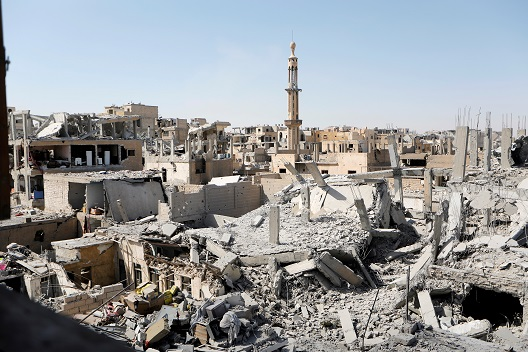
The post-ISIS transition in Iraq exposes this logic with particular clarity. By 2017, the territorial defeat of ISIS was reframed internationally as a stabilisation opportunity. Yet the scale of devastation made genuine post-conflict transformation structurally implausible. At its peak, ISIS governed territory inhabited by nearly eight million people. The campaign to defeat it displaced more than nine million Iraqis, according to the International Organization for Migration, flattening entire cities such as Mosul and overwhelming fragile state institutions. Iraq’s judiciary was incapable of processing mass atrocity crimes, and security forces central to the counter-ISIS campaign faced credible allegations of abuse.
Under these conditions, justice was not merely slow. It was politically destabilising. Investigating collaboration risked collapsing distinctions between survival and culpability. Prosecuting abuses threatened to implicate militias and state actors essential to the post-war order. A comprehensive reckoning would have endangered the very arrangements that made “liberation” possible.
It is here that reconciliation ceased to be a social aspiration and became a donor technology. UNDP’s Funding Facility for Stabilization, supported by the United States, the European Union, Germany, and the World Bank, prioritised rapid service restoration, debris removal, and the facilitation of returns. These priorities reflected donor timelines, funding cycles, and political fatigue. Justice and accountability were acknowledged rhetorically, but deferred indefinitely. Stability, not legitimacy, became the metric of success.
This logic is replicated across the Sahel. In Mali and Burkina Faso, counterinsurgency campaigns have produced mass displacement, civilian casualties, and deep mistrust between populations and the state. Courts are weak or non-functional. Investigations into security force abuses are politically explosive. Yet international engagement, channelled through the EU Trust Fund for Africa, World Bank Sahel programmes, and UN stabilisation missions, continues to prioritise reconciliation and social cohesion as tools for managing insecurity.
Across contexts, reconciliation arrives early not because communities are healed, but because the global system needs to exit conflict faster than justice allows.
How reconciliation reorganises violence into a social burden
Once reconciliation is embedded at the level of donor and state policy, it begins to reshape everyday life. This is where reconciliation stops being rhetoric and becomes a practice of governance, altering how violence is named, where responsibility is located, and what kinds of claims are considered legitimate.
In post-ISIS Iraq, this shift is evident in how culpability was handled. Rather than transparent judicial processes capable of distinguishing coercion from collaboration, reconciliation was operationalised through informal security clearances, community approvals, and loyalty pledges that determined whether families could return home or access services. These mechanisms were framed as pragmatic solutions to a complex problem. In reality, they replaced law with proximity.
Families accused of ISIS affiliation were not judged individually but categorised collectively, with guilt transmitted through kinship rather than evidence. According to IOM data, more than one million Iraqis remain displaced years after the end of major hostilities, many due not to physical destruction but to informal return bans enforced in the name of reconciliation. UNICEF estimates that over forty-five thousand children are affected by documentation gaps linked to perceived ISIS affiliation, limiting access to education and healthcare.
These outcomes are often described as failures of reconciliation. Analytically, they are its core function. Reconciliation converts claims to justice into obligations of restraint. It transforms unresolved violence into a social problem communities must manage, negotiate, and absorb.
Political theory clarifies this shift. Reconciliation operates less as a juridical process and more as a biopolitical instrument, regulating who may live where, under what conditions, and with what degree of visibility. Violence is not eliminated. It is normalised, domesticated, and diffused across everyday life. The state retreats from adjudication while retaining the power to surveil, restrict, and exclude.
The Sahel mirrors this logic under different institutional conditions. In central Mali, reconciliation initiatives framed as traditional mediation are used to address conflicts rooted in land dispossession, ethnic targeting, and militarised governance. These are political conflicts, yet reconciliation reframes them as communal misunderstandings, narrowing their scope so they can be endured rather than contested. According to UN reporting, communities are encouraged to reconcile even as armed actors, including state forces, remain active and unaccountable.
In both Iraq and the Sahel, reconciliation does not resolve violence. It changes its address, moving harm from courts and commissions into kitchens, classrooms, and family life.
Endurance mistaken for peace, and the conditions for recurrence
The most dangerous effect of reconciliation as currently practised is that it produces the illusion of peace. When violence recedes from headlines, markets reopen, and daily routines resume, reconciliation is credited with restoring stability. What is actually occurring is collective adaptation to unresolved harm.
Communities learn how to survive carefully. Which memories cannot be voiced. Which questions must remain unasked. Which injustices must be absorbed to preserve fragile coexistence.
Women’s role in reconciliation exposes this contradiction most clearly. Across post-conflict settings, women are positioned as mediators, caregivers, and symbols of resilience, even as they remain excluded from decision-making and justice mechanisms. UN Women data shows that women constitute less than ten percent of formal peace negotiators globally, yet they perform the majority of unpaid reconciliation labour at the community level. This is not empowerment. It is the outsourcing of stability.
In post-ISIS Iraq, Yazidi women are celebrated internationally while more than two hundred thousand Yazidis remain displaced and mass graves continue to be exhumed years after the genocide. In the Sahel, women are mobilised as peace brokers in regions where insecurity persists and accountability is absent. Their endurance becomes proof that reconciliation is working, even as the conditions that produced violence remain intact.
This misreading has measurable consequences. UNDP’s Journey to Extremism research shows that perceived injustice, humiliation, and exclusion are among the strongest predictors of renewed violence, particularly among young people in post-conflict societies. World Bank fragility assessments consistently find that countries prioritising stability over accountability are significantly more likely to relapse into conflict within a decade.
What reconciliation could look like if it were not doing the work of avoidance
If reconciliation has become a governing shortcut in post-conflict settings, the question is not whether reconciliation should be abandoned, but what must come before it, around it, and after it for it to mean something other than managed endurance. African post-conflict experiences, often misread as success stories or failures depending on ideological preference, offer more useful lessons than the global system is willing to admit, precisely because they expose both the possibilities and limits of reconciliation when it is anchored, however imperfectly, in accountability.
Rwanda is the most frequently cited and least carefully analysed case. In the aftermath of the 1994 genocide, Rwanda did not prioritise reconciliation as an initial step. It prioritised order, accountability, and narrative control, and only later layered reconciliation onto those foundations. The gacaca courts, for all their flaws and coercive elements, were not designed as dialogue forums. They were mechanisms to process an overwhelming volume of crimes in the absence of a functioning judiciary, explicitly naming perpetrators, victims, and acts of violence. By 2012, gacaca courts had tried an estimated 1.9 million cases, making visible the scale of harm rather than deferring it indefinitely.
This sequencing matters. Reconciliation in Rwanda was not allowed to substitute for accountability; it was made conditional on confession, naming, and punishment, however unevenly applied. The state’s heavy hand in shaping memory and political space raises serious concerns, but the core lesson remains uncomfortable for today’s post-conflict orthodoxy: peace was not built by asking communities to coexist first and reckon later. Reckoning came early, reconciliation later, and even then, on the state’s terms.
Other African cases offer different but complementary lessons. In Sierra Leone, the coexistence of the Special Court and the Truth and Reconciliation Commission reflected an explicit recognition that reconciliation could not carry the burden of justice alone. While both institutions were imperfect, their parallel operation prevented reconciliation from becoming the sole horizon of post-war governance. Victims had forums to testify. Perpetrators faced legal consequences. Reconciliation emerged unevenly, but it was not imposed as a substitute for redress.
Northern Uganda presents another instructive contrast. There, traditional reconciliation rituals such as mato oput were widely promoted by international actors as culturally appropriate solutions to the violence of the Lord’s Resistance Army conflict. Yet research from the region shows that these rituals were often deployed in the absence of meaningful reparations, land restitution, or accountability for state violence. Reconciliation ceremonies provided symbolic closure without material repair, leaving deep grievances intact, particularly among displaced communities. The lesson is clear: cultural legitimacy does not compensate for structural absence.
Taken together, these cases point toward a set of policy principles that directly challenge current post-conflict practice.
First, reconciliation must be explicitly sequenced after accountability, not framed as a prerequisite for it. This does not mean waiting for perfect justice, but it does mean establishing visible mechanisms that name harm, distinguish coercion from culpability, and signal that violence will not simply be absorbed socially. Expediency cannot justify silence.
Second, reconciliation must be decoupled from donor exit timelines. As long as reconciliation is tied to funding cycles, return benchmarks, and stabilisation metrics, it will continue to privilege calm over legitimacy. Long-term justice mechanisms, including reparations, land restitution, and civil documentation, must be funded as core recovery infrastructure, not optional add-ons.
Third, reconciliation must be material, not merely relational. African post-conflict experiences repeatedly show that coexistence without economic repair reproduces resentment. Land disputes, access to services, and livelihood recovery are not peripheral to reconciliation; they are its substance. Dialogue without redistribution asks too much of those who lost the most.
Fourth, women’s participation must shift from symbolic stabilisation to structural power. Rwanda’s post-genocide political settlement, whatever its democratic limitations, demonstrates what happens when women are not only social healers but institutional actors, shaping law, policy, and resource allocation. Inclusion that stops at mediation perpetuates extraction.
Finally, reconciliation must include the right to refusal. One of the most damaging assumptions in current practice is that reconciliation is always desirable and always urgent. African cases show that forced or premature reconciliation deepens harm. Communities must be allowed time, space, and the option not to reconcile until conditions are credible.
The overarching lesson is not that Africa offers a template to be replicated, but that it exposes the fiction at the heart of contemporary reconciliation policy: that societies can be asked to heal without first being acknowledged, repaired, or protected. Where reconciliation has had any durability, it has been because it followed, rather than replaced, difficult political choices.
Until global post-conflict governance internalises this lesson, reconciliation will remain what it is today: a language of closure imposed on societies that are still living with the violence.
Conclusion
What post-ISIS Iraq and the Sahel reveal is not a failure of goodwill, but a failure of global governance imagination. Reconciliation has been repurposed from a social process grounded in justice into a policy instrument that allows states and donors to declare wars over while leaving violence structurally intact.
What appears as peace in policy documents is often endurance on the ground. What is celebrated as healing is frequently silence. And what is called reconciliation is too often a demand that communities live with harm they were never given the power to address.
Until reconciliation is disentangled from donor timelines, funding logics, and political convenience, and re-anchored in accountability, material repair, and the right to refuse premature closure, post-conflict societies will continue to live with violence rather than beyond it. The war may end, but the conflict, carefully managed and politely renamed, remains.
 FaultLines